The short answer
If your business is registered under GST and you rent a shop, office, godown or any other commercial property from a landlord who is not registered, you, the tenant, pay 18% GST under the reverse charge mechanism (RCM). The landlord charges no GST. The rule applies from 10 October 2024 (Notification 9/2024-Central Tax (Rate), entry 5AA). You pay the tax in cash in GSTR-3B and, in most cases, claim the same amount back as input tax credit in the same return.
When does this RCM apply?
All four conditions must be true:
| Condition | What it means |
|---|---|
| The property is not a residential dwelling | Shops, offices, warehouses, factory sheds, commercial land and buildings |
| The landlord is not registered under GST | Usually an individual owner whose turnover is below the registration limit |
| The tenant is registered under GST | Any regular taxpayer with a GSTIN |
| The tenant is not a composition taxpayer | Composition taxpayers were taken out from 16 January 2025 (Notification 7/2025-Central Tax (Rate)) |
When it does not apply
- The landlord is registered. Then it is a normal supply: the landlord charges 18% GST on the rent invoice and you claim ITC from your GSTR-2B.
- You are not registered. An unregistered tenant does not pay this RCM.
- You are a composition taxpayer. Exempt from 16 January 2025. For rent paid between 10 October 2024 and 15 January 2025, composition tenants were liable.
- Residential property. Renting a residential dwelling to a registered person has its own RCM entry (from 18 July 2022), with an exemption when a proprietor rents it in a personal capacity for their own residence. That is a separate rule from this one.
How to pay it, step by step
- Raise a self-invoice. Because the landlord is unregistered, you issue the invoice yourself under Section 31(3)(f). Rule 47A gives you 30 days from receiving the service to issue it.
- Issue a payment voucher when you pay the rent (Section 31(3)(g)).
- Work out the date. Under Section 13(3), the time of supply for RCM services is the earlier of the payment date and the 61st day after the date of the landlord's bill or invoice.
- Declare and pay in GSTR-3B Table 3.1(d), "Inward supplies (liable to reverse charge)". RCM tax must be paid in cash. It cannot be set off from your credit ledger.
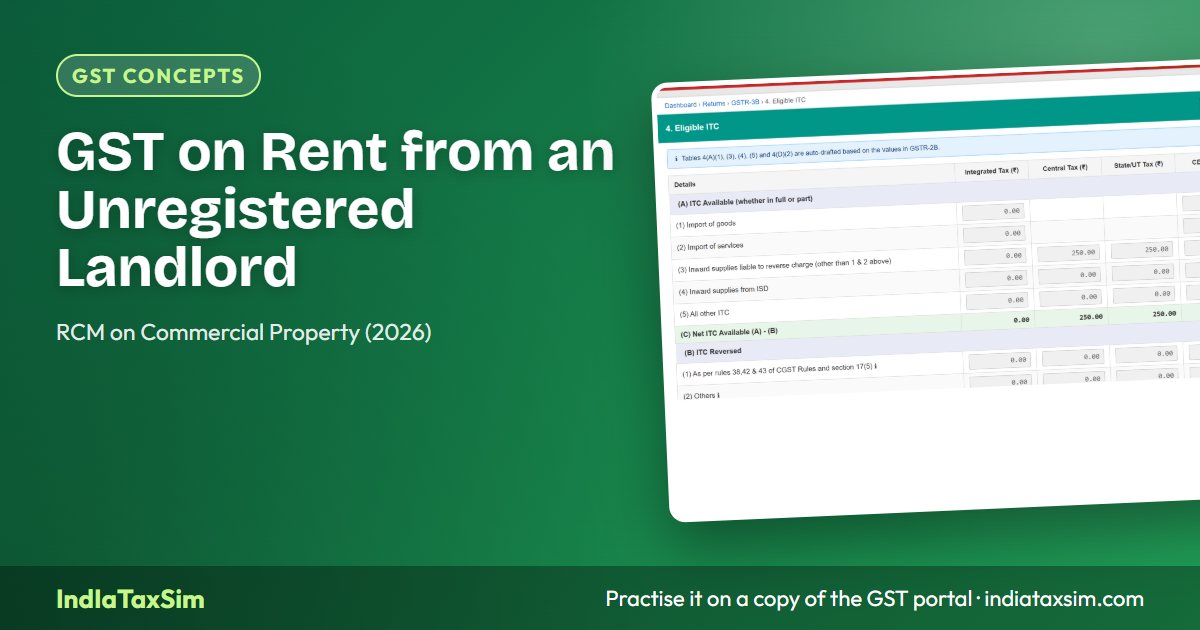
- Claim the ITC in Table 4A(3), "Inward supplies liable to reverse charge", in the same GSTR-3B, if the premises are used for your business.
Worked example
Ravi runs a registered shop in Kochi (Kerala). He pays ₹50,000 a month rent to an unregistered landlord, also in Kerala, so the supply is intra-State.
| Item | Amount |
|---|---|
| Rent (taxable value) | ₹50,000 |
| CGST 9% under RCM | ₹4,500 |
| SGST 9% under RCM | ₹4,500 |
| Paid in cash in GSTR-3B 3.1(d) | ₹9,000 |
| ITC claimed in GSTR-3B 4A(3) | ₹9,000 |
The ₹9,000 leaves his cash ledger this month, and the same ₹9,000 enters his credit ledger, where it can pay his output tax. For a business making taxable sales, the net cost is the cash tied up, not the tax. If the landlord were in another State, it would be ₹9,000 IGST instead.
Common mistakes
- Paying the RCM from the credit ledger. Not allowed. Deposit cash through a PMT-06 challan first.
- Forgetting 3.1(d) because there is no invoice in GSTR-2B. An unregistered landlord files nothing, so nothing appears in 2B. You must add it yourself.
- Missing the self-invoice. Your ITC depends on a valid document. Issue the self-invoice within 30 days.
- Assuming the landlord's registration status. Check the landlord's PAN with Search Taxpayer. If a GSTIN exists, ask for a GST invoice instead.
- Paying late. Interest at 18% a year applies to RCM tax paid late, and because RCM is always paid in cash, all of it counts. See interest on late GST payment.
Where it shows in your returns
| Return | Table | What goes there |
|---|---|---|
| GSTR-3B | 3.1(d) | Taxable value and tax on the rent (liability, paid in cash) |
| GSTR-3B | 4A(3) | The same tax as ITC |
| GSTR-9 | 4G, 6C | Annual totals of RCM tax paid and ITC claimed on inward supplies from unregistered persons |
For the wider picture of reverse charge, including GTA, advocate and director services, read our guide to RCM in GST.
Practise it before your next return
On IndIaTaxSim, a safe copy of the GST portal, you can enter reverse charge supplies in GSTR-3B Table 3.1(d), pay the challan, claim the ITC in Table 4A(3) and see both ledgers change. Module 19 of the GST Portal Walkthrough covers RCM, and Chapter 7 of the GST Practice Lab has RCM cases to work through.
📚 Continue Learning
📖 You Might Also Like
IndIaTaxSim Team
GST compliance experts building India's most complete GST simulation platform. All articles are reviewed for accuracy against the latest GSTN portal updates.