The short answer
A delivery challan is the document that goes with goods when they leave your premises but no sale has happened yet, or the sale cannot be invoiced yet. Rule 55 of the CGST Rules lets you move goods on a delivery challan instead of a tax invoice in a few listed cases, such as sending goods to a job worker. It looks like an invoice, but it does not record a sale, so it creates no output tax liability by itself.
When can you use a delivery challan?
| Case | Rule | Example |
|---|---|---|
| Supply of liquid gas where the quantity is not known when it leaves | 55(1)(a) | A tanker of LPG; the tax invoice follows once the delivered quantity is known |
| Goods sent for job work | 55(1)(b) | Steel sheets sent to a job worker for cutting and returned |
| Goods moved for reasons other than a supply | 55(1)(c) | Stock taken to an exhibition, sent for repair, or moved between two godowns under the same GSTIN |
| Goods sent on approval (sale or return) | Sec 31(7) | Jewellery sent to a customer to choose from; the invoice is issued when the customer keeps it, or 6 months after removal, whichever is earlier |
| Other supplies notified by the Government | 55(1)(d) | Only where a notification says so |
A transfer to your own branch in another State is different. The two GSTINs are distinct persons, so that movement is a supply and needs a tax invoice, not a delivery challan.
What a delivery challan must show (Rule 55(2))
- Date and a serial number of up to 16 characters (one or more series, unique for the financial year)
- Name, address and GSTIN of the consignor
- Name, address and GSTIN or UIN of the consignee, if registered
- HSN code and description of the goods
- Quantity (a provisional quantity where the exact quantity is not known)
- Taxable value
- Tax rate and tax amount (CGST, SGST/UTGST, IGST, cess) where the goods are being moved for supply to the consignee
- Place of supply, for inter-State movement
- Signature of the supplier or authorised representative
Three copies (Rule 55(3))
| Copy | Marked | Who keeps it |
|---|---|---|
| 1 | ORIGINAL FOR CONSIGNEE | Goes with the goods to the receiver |
| 2 | DUPLICATE FOR TRANSPORTER | Stays with the driver or transporter |
| 3 | TRIPLICATE FOR CONSIGNOR | Stays in your records |
Delivery challan and the e-way bill
When goods move on a delivery challan, the details are declared in the e-way bill where one is required (Rule 55(4) read with Rule 138). On the e-way bill portal you pick Delivery Challan as the document type and the reason, such as job work, exhibition or own use.
- The usual threshold is a consignment value above ₹50,000.
- For goods sent by a principal to a job worker in another State, and for handicraft goods sent inter-State by a seller who is exempt from registration, an e-way bill is needed whatever the value.
- When no e-way bill is needed, the delivery challan itself travels with the goods.
Goods sent in parts (SKD/CKD or batches)
If a machine is sent in semi-knocked down or completely knocked down condition, or in lots, Rule 55(5) works like this: issue the full tax invoice before the first lot leaves, then a delivery challan for each lot that refers to that invoice. Each lot travels with its challan and a certified copy of the invoice, and the original invoice goes with the last lot.
Job work: what happens next
Inputs sent to a job worker must come back within 1 year and capital goods within 3 years (moulds, dies, jigs and tools excluded), or they are treated as supplied on the day they left (Section 143). The challans are reported in Form ITC-04: half-yearly if your aggregate turnover is above ₹5 crore, annually (by 25 April) if it is ₹5 crore or less.
Report your challans in GSTR-1 Table 13
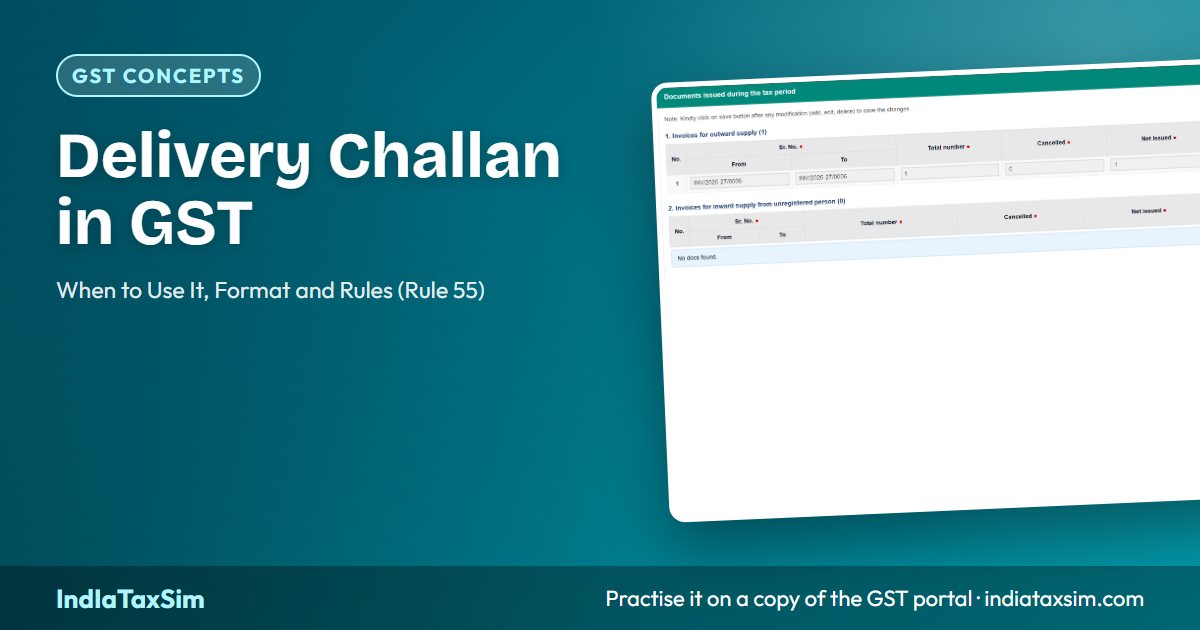
Table 13 of GSTR-1, Documents issued during the tax period, has separate rows for delivery challans: for job work, for supply on approval, for liquid gas, and for other cases. For each series you enter the serial number from and to, the total number, the number cancelled and the net issued. Cancelled challans still count in the total.
Common mistakes
- Using a delivery challan for a sale. If the goods are sold, a tax invoice is needed at the time of removal (Section 31). A challan does not postpone the tax.
- Using a challan for an inter-State branch transfer. Different GSTINs are distinct persons, so a tax invoice is required.
- Forgetting the invoice for goods on approval. If the customer neither returns nor accepts the goods, the invoice is due 6 months after removal.
- No e-way bill for inter-State job work. It is required even below ₹50,000.
- Leaving challans out of Table 13. Every series you used belongs in GSTR-1 for the period.
Practise it before you do it for real
On IndIaTaxSim, a safe copy of the GST portal, you can fill GSTR-1 Table 13 (documents issued), generate e-way bills and file ITC-04 for job work. Module 12 of the GST Portal Walkthrough covers the HSN summary and documents issued, and Chapter 11 of the GST Practice Lab has a job-work case that ends in ITC-04. For the invoice itself, see our GST invoice format guide.
📚 Continue Learning
📖 You Might Also Like
IndIaTaxSim Team
GST compliance experts building India's most complete GST simulation platform. All articles are reviewed for accuracy against the latest GSTN portal updates.